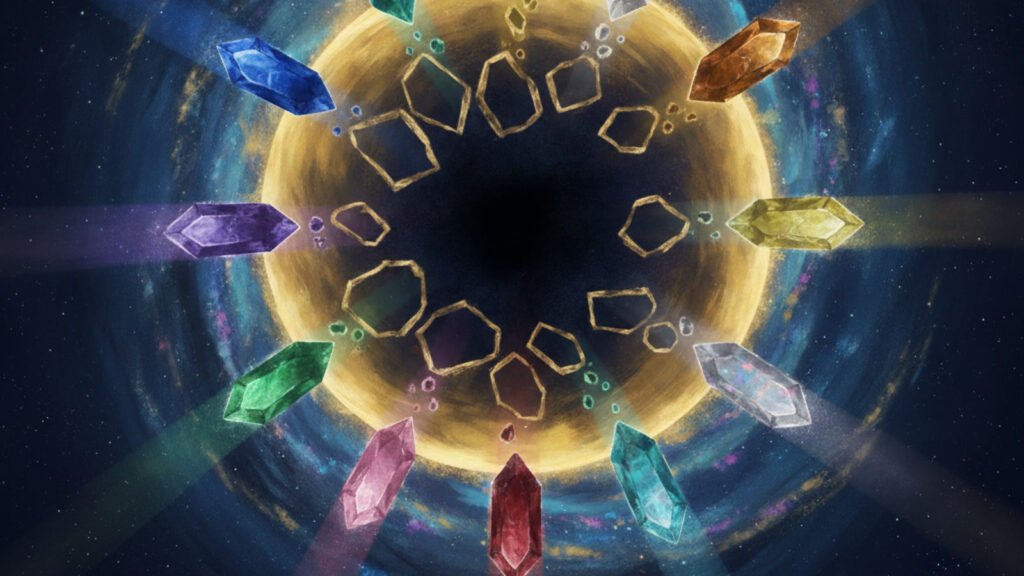
The Shattering of Adonalsium produced sixteen equal pieces of the power of creation. Ten thousand years later that roster is a mess. Four Shards are dead, four are fused into two Vessels, one has fled her own planet, and the single most powerful entity in the cosmere is a hospital-building king from Kharbranth who is currently in hiding. So the interesting question is not who holds what. It is that the number sixteen has been shrinking since the day it was set, and almost every serious Shard theory is really a theory about where that consolidation stops.
Heavy spoilers throughout for the Stormlight Archive through book five, for Mistborn era two, and for Elantris, Warbreaker and Yumi and the Nightmare Painter.
What a Shard actually is
Adonalsium was killed on the planet Yolen by a conspiracy of at least seventeen people. The power broke into sixteen pieces, each one polarized toward a single aspect of the whole, and sixteen of those conspirators picked up a piece and Ascended. They became the first Vessels. Everything in the cosmere that looks like a god is downstream of that one event.
The distinction that trips up most new readers is between the Shard and the Vessel. The Shard is the power, essentially infinite, and most of it sits in the Spiritual Realm where distance stops applying, which is why a Vessel feels its Shard on every world at once. The Vessel is a person serving as a focus for it. Sazed put it best: Ruin and Preservation inhabited power the way a person inhabits flesh and blood.
The second thing to understand is Intent. Each Shard is polarized toward one idea, and that idea grinds down the mind holding it, gaining ground over centuries. Preservation was literally incapable of initiating change, even to save its own world. Odium is passion and hatred with the divine love stripped out, because that part of Adonalsium went into Devotion. A Vessel who fights long enough can bend how an Intent expresses itself, but cannot overwrite it. That single rule is why the fan solution of “just hand the power to a good person” has never once worked.
All sixteen Shards of Adonalsium, and who holds them now
| Shard | Vessel | World | Status |
|---|---|---|---|
| Honor | Taravangian, formerly Tanavast and Dalinar Kholin | Roshar | Merged into Retribution |
| Odium | Taravangian, formerly Rayse | Braize and Roshar | Merged into Retribution |
| Cultivation | Koravellium Avast | Unknown, formerly Roshar | Whole, in hiding |
| Preservation | Sazed, formerly Leras, Kelsier and Vin | Scadrial | Merged into Harmony |
| Ruin | Sazed, formerly Ati | Scadrial | Merged into Harmony |
| Devotion | Aona, deceased | Sel | Splintered, part of the Dor |
| Dominion | Skai, deceased | Sel | Splintered, part of the Dor |
| Ambition | Uli Da, deceased | Threnody | Splintered by Odium |
| Virtuosity | Unknown, female | Komashi | Splintered herself |
| Endowment | Edgli | Nalthis | Whole |
| Autonomy | Bavadin | Taldain, plus avatars elsewhere | Whole and expanding |
| Invention | Chan Ko Sar | Grand Apparatus | Whole |
| Valor | Medelantorius | Unknown | Whole |
| Reason | Euridrius | Unknown | Whole |
| Mercy | Unknown | Unknown | Whole |
| Whimsy | Unknown | Unknown | Whole |
Sixteen Shards, but only ten Vessels still standing, and two of those ten hold two Shards each. Three of the sixteen are gods nobody has met and nobody can place on a map.
The four that died, and the one who did it to herself
Three of the four deaths are the same story with different addresses. Shortly after the Shattering, Odium decided he wanted to be the only god left in the cosmere, and went hunting.
Devotion and Dominion went first, on Sel, roughly ten thousand years before the Night of Sorrows. Odium did not simply attack them. He turned them against each other, then killed both while they were wounded, and forced the bulk of their power into the Cognitive Realm, where it still sits as the Dor. Everything strange about Selish magic, the way it is locked to geography and the way it behaves like something under pressure, traces back to two corpses that were never allowed to settle. That is the background radiation of Elantris, a book about a magic system that stopped working while nobody inside it understands why.
Ambition died less than two thousand years later. Uli Da had taken the Shard to the Threnodite system, and Odium ranked her first on his list of rivals. Mercy was involved in that fight, on terms that have never been explained. Odium tore chunks off Ambition, chased her out of the system, and finished her somewhere else. Threnody’s shades, its brutal little rules for staying alive, and the anti-Investiture entities called the Evil are all descendants of that wound. The story that shows you the aftermath is “Shadows for Silence in the Forests of Hell”, collected in Arcanum Unbounded.
Virtuosity is the exception, and she is the reason this section matters. Nobody killed her. Her Intent was artistic talent and appreciation, she spent millennia wandering the cosmere chasing creative expression without settling anywhere for long, and then she Splintered herself near Komashi for reasons that have never been given. Her splinters became the hijo, the spirits that make life on that planet possible at all, which readers of Yumi and the Nightmare Painter have already met without being told what they were. A Shard chose to stop being a Shard, and used the remains to build something. Any theory that treats the sixteen as pieces on a board has to explain her.
Two Vessels holding four Shards
Only two Vessels have ever held more than one Shard, and the comparison is the most instructive one available right now. Sazed took up Ruin and Preservation at the end of The Hero of Ages and became Harmony. The two Intents are opposites, and that is exactly the problem. Harmony is explicitly described as having misaligned powers, a god built out of an argument. Three centuries later, in The Lost Metal, he is visibly straining. Autonomy manages to blind him, his Intent holds but a shadow version of himself manifests nearby, and the name waiting for whatever he is becoming is Discord.
Retribution is the opposite case, and that should worry you more. When Dalinar Ascended to Honor at the end of Wind and Truth and then renounced the oaths, including the ones engraved into the Shard itself, he vacated the position, and Honor and Odium settled together into Taravangian. Retribution’s own verdict on the comparison is blunt: Harmony’s powers were misaligned, while Honor and Odium wanted nearly the same things, so they would work together.
The merger did something else too. Odium had been sealed inside the Rosharan system for thousands of years by an oath with Honor. Retribution is not Odium, so Retribution is not sealed. It left, then immediately went into hiding, because a brand new aligned Shard turned the attention of every other Shard toward it. Cultivation fled the system in the same moment and has not been located since. The end of book five was neither a victory nor a defeat: it was a god getting out of a cage that had held for eight thousand years.
The Shards we barely know, and what book five gave us
Three Vessel names arrived in book five. Chan Ko Sar holds Invention, on a world called the Grand Apparatus. Medelantorius holds Valor. Euridrius holds Reason. Names on their own are not much, but Invention is a loaded one in a cosmere where magic is being reverse engineered into technology and Scadrial is industrializing at speed. A Shard whose entire Intent is invention, sitting on a world named after a machine, is not a detail dropped for decoration.
Mercy and Whimsy still have no known Vessel and no known address. What we have instead is a scene. Around the time of the True Desolation, Hoid asked Harmony to reach out to other Shards about the threat Odium posed. Whimsy left Harmony with the impression of being no use at all, which fits an Intent that is explicitly neither calculating nor deliberate. Mercy left him troubled. That single word is doing an enormous amount of work.
The theories worth arguing about, graded by evidence
Something is wrong with Mercy. The strongest open question in the cosmere, because two independent facts point at it. Mercy participated somehow in the clash that Splintered Ambition, one of the most destructive events in cosmere history, and centuries later a conversation with Mercy left Harmony troubled. A Shard named Mercy taking part in the killing of another god is either the sharpest irony Sanderson has written or evidence that an Intent has warped its Vessel past recognition. There is no answer yet, only a very deliberate silence.
Cultivation knew, and this is the outcome she chose. Medium evidence, high appeal. She spent decades pruning both Dalinar and Taravangian, she sees further ahead than almost anyone alive, and she left the Rosharan system in the same instant Retribution was born. The theory says she engineered a survivable ending rather than a happy one. The counter-argument is simpler and just as available: she gambled, lost control of her own candidate, and ran.
Autonomy is the actual endgame, not Retribution. Bavadin does not sit on a planet and wait. She builds avatars, separate identities carrying pieces of her power, on First of the Sun, on Obrodai, formerly on Scadrial, and she seeded a religion on Scadrial long before the Final Empire existed purely so she would have followers there later. In The Lost Metal she blinded Harmony, massed armies at a perpendicularity, then retreated on purpose to try again later. Every other surviving Shard scales in one place. She is the only one scaling sideways.
Someone will try to reassemble Adonalsium. Weaker on evidence, strong on structure. In theory a single Vessel could hold all sixteen and recreate what was broken, although competing theories hold that the attempt would destroy the Vessel, or that it simply cannot be done. Of the one hundred and twenty possible pairings, exactly two have ever been seen. Two data points is not a trend, but one of the two has just walked out of its prison.
Frequently asked questions
How many Shards of Adonalsium are there?
Sixteen. All sixteen are now named: Honor, Odium, Cultivation, Ruin, Preservation, Devotion, Dominion, Ambition, Endowment, Autonomy, Invention, Valor, Reason, Mercy, Whimsy and Virtuosity. Four of them have been Splintered and four are held two at a time, so there are far fewer active gods than the number suggests.
Which Shard is the most powerful right now?
Retribution, the combination of Odium and the majority of Honor held by Taravangian. All sixteen Shards began with equal power, but many have been diminished by conflict or by Investing a world. Retribution’s advantage is that its two Intents are aligned rather than opposed, which is the exact comparison it draws against Harmony.
Which Shards are dead?
Four have been Splintered and left without a Vessel. Odium killed Devotion, Dominion and Ambition during his early campaign to become the only god in the cosmere. Virtuosity Splintered herself near Komashi, and nobody knows why.
Can two Shards be combined?
Yes, and it has happened twice. Sazed holds Ruin and Preservation as Harmony, and Taravangian holds Odium and most of Honor as Retribution. Combining Shards creates a new Intent out of the resonance between the old ones, but the original Intents still exist inside and can pull against each other when they are not aligned.
Which books do I need to read to understand the Shards?
The core path is the Mistborn era one trilogy for Ruin and Preservation, the Stormlight Archive for Honor, Odium and Cultivation, Warbreaker for Endowment, Elantris for Devotion and Dominion, and Arcanum Unbounded for the star charts and the essays by Khriss that name most of the rest. Wind and Truth is where the largest single batch of new Shard information lands.
The Way of Kings is the perfect entry point. Available in print, Kindle, and audiobook.
The Stormlight Archive audiobooks - narrated by Michael Kramer & Kate Reading - are 40–57 hours each. The best use of a commute in fantasy history.