Full spoilers for Oathbringer below, plus context from Rhythm of War and Wind and Truth. If you have not finished book three, stop here and come back.
The short version: Odium tries to break Dalinar Kholin by handing back the memory of Rathalas, where Dalinar burned a city with his own wife inside it. Dalinar refuses to give up the guilt, speaks the Third Ideal of the Bondsmiths, and opens Honor’s Perpendicularity in the middle of the battlefield. Every gemstone in Thaylen City fills with Stormlight, his friends walk back out of Shadesmar, and Odium runs. But the thing that shapes the next two books happens minutes earlier, in an exchange most readers skim past: Dalinar challenges Odium to a contest of champions, and Odium says yes.
The battle was rigged before the first shot
Thaylen Field is not a fair fight, and it was never meant to be. Taravangian had arranged for most of the city’s defense force to be sent away, and opened the Urithiru Oathgate so the tower would be under attack at the same moment, making reinforcements impossible. Then the Everstorm stalls above the city instead of passing over, and ten thousand singer souls waiting in Shadesmar use that stall to cross into the Physical Realm, two of them digging out of the rock as thunderclasts. Odium steps onto the shore in a body of golden carapace to run the battle in person.
The nastiest move comes next. Nergaoul, the Unmade responsible for the Thrill, floods the field as red mist, and the voidspren seize human hosts, something that had never happened in any previous Desolation. Sadeas’s veterans turn around and attack the people they were sent to protect, while the thunderclast Yushah tears open the Thaylen Gemstone Reserve to scatter the King’s Drop, one of the only objects on Roshar capable of holding an Unmade.
Odium’s offer, and why it nearly works
Dalinar walks out to meet him alone, carrying his copy of The Way of Kings. He challenges Odium to a contest of champions, the old Rosharan mechanism for settling a war without fighting it. Odium accepts, then explains, pleasantly, that he has been grooming Dalinar for years to be his champion. Then he opens the floodgates: the full weight of the Thrill and the full memory of the Rift at Rathalas, where Dalinar ordered the valley burned and Evi was inside the walls, having slipped away to beg for peace.
The offer that follows is not a threat. It is mercy, and that is exactly why it is dangerous. Odium tells him the guilt was never his, that a god of passion moved his hand, that he can simply stop hurting. Dalinar has taken that deal once already: years earlier he climbed to the Nightwatcher to ask for it, and Cultivation intervened and took every memory of Evi instead, which is why the reader spent two and a half books inside an edited man without noticing the hole.
What “I am Unity” actually does
Dalinar refuses. Not by denying the crime, which is the version a weaker book would have written, but by claiming it. That is the Third Ideal of the Bondsmiths, and the wording matters: “I will take responsibility for what I have done. If I must fall, I will rise each time a better man.”
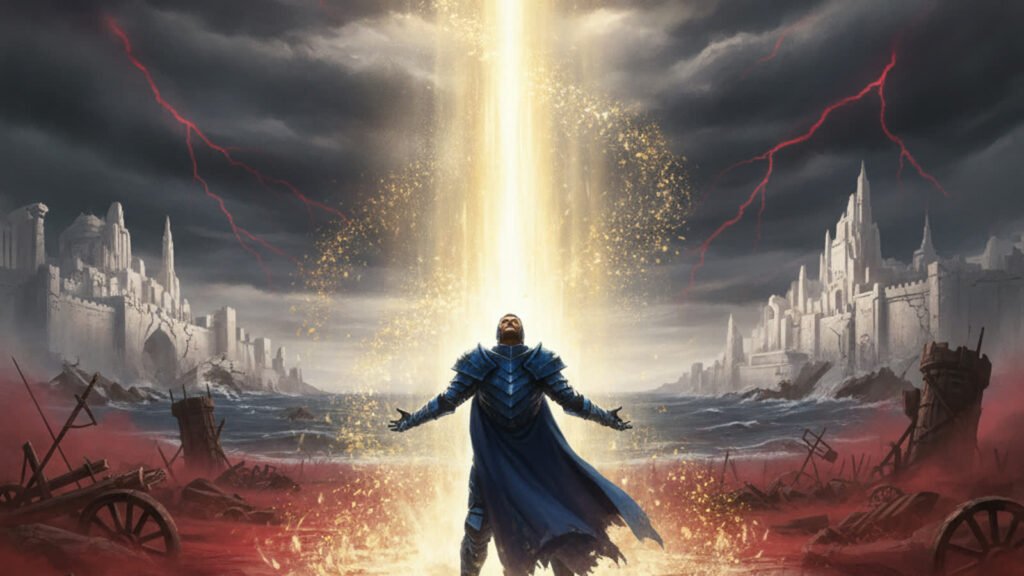
Then he says “I am Unity,” and the mechanics of the Cosmere do the rest. A Bondsmith Connects things. At the Third Ideal, what Dalinar Connects is the Physical, Cognitive and Spiritual Realms themselves, at a single point, in the middle of a battlefield. That is Honor’s Perpendicularity, normally a fixed feature of a planet rather than something a man opens with a sentence.
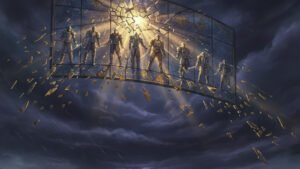
The effects land in seconds. Gloryspren and Stormlight pour out in a column, every gem in Thaylen City infuses at once, and every Radiant in the battle suddenly has unlimited fuel. A road opens to Shadesmar, and Adolin, Shallan and Kaladin, stranded there for most of the book, walk back into the fight. Odium flees the field, leaving his own army behind.
Everything turns at once
The perpendicularity does not win the battle by itself. It hands five characters the moment they have been building toward, all in the same stretch of chapters. Jasnah tears through the enemy line with the near infinite Stormlight. Shallan builds an illusory army solid enough to hold Sadeas’s possessed troops. Adolin wounds the second thunderclast before Renarin arrives with healing and finishes it. Teft, up at Urithiru, speaks the Third Ideal and opens the Oathgate for reinforcements. And on the enemy’s own ships, Venli bonds a spren named Timbre and becomes the first singer Surgebinder of the modern era, unnoticed by either side.
Amaram swallows a god
With Dalinar refusing the job, Odium needs a different vessel for the gemstone holding the Unmade Yelig-nar. It goes to Amaram, who attacks Dalinar, is turned back by Kaladin, and swallows the gem. He grows grotesque carapace under his Shardplate and gains all ten Surges, which on paper makes him the strongest combatant on the field.
Kaladin fights him anyway, runs out of Stormlight, and is about to die when Rock, who as a Horneater cook had refused to kill for the entire series, picks up a Shardbow and puts two shots through Amaram. The rescue costs Rock the vow he kept his whole life, and the book treats it as a wound rather than a cheer.
Trapping the Thrill
The last piece is the quiet one. Lift sneaks back into the city after being evacuated, and Dalinar sends her after the King’s Drop. Szeth, hovering above the battle with Nale, chooses that moment to swear the Third Ideal of the Skybreakers, picks Dalinar as the ideal he will follow, and drops into the fight with Nightblood drawn. Together they recover the gemstone and shake their Fused pursuers with a decoy King’s Drop built by Shallan. Lift carries the real one into the red mist, where Dalinar deliberately embraces the Thrill to lure Nergaoul in and traps the Unmade in the stone. Sadeas’s army simply stops.
The real ending is a contract
Thaylen Field is a win. It is not the point. What survives into the rest of the series is the agreement made before the fighting started, because a god who has publicly accepted a contest of champions cannot simply crush his opponent afterward without breaking the rules that bind a Shard. That constraint is why Odium spends Rhythm of War working through proxies, and why the ten day countdown of Wind and Truth exists at all. Oathbringer converts the war into a duel with a date on it, then makes you wait two books to learn who Odium picks.
A second constraint hides in the same battle. Renarin’s corrupted spren means beings who see the future cannot see around him, which is why his own vision of Jasnah killing him came out wrong. Odium’s strategy runs on prediction, and the boy everyone treated as fragile is the blind spot. Our ranking of the biggest Stormlight twists puts that reveal in the top six for exactly this reason.
Eight days later, Taravangian sells the war
After the battle Taravangian confesses part of what he did: plotting for the throne of Jah Keved, using Szeth as an assassin, knowing the Desolation was coming. He does not admit that the Diagram exists, and does not admit that he brought the singers to Urithiru. Dalinar never fully trusts him again, but does not break with him either.
Eight days later, on one of his days of below average intelligence, Odium comes to him in a vision. Taravangian, who understands that Odium can no longer afford to face Dalinar directly, negotiates anyway. The deal: the Diagram’s information and Jezrien’s Honorblade, in exchange for sparing the people of Kharbranth, meaning the city, anyone born into it, and their spouses. Taravangian gets one city. Odium gets an intelligence network inside the coalition, and Taravangian gets close enough to a Shard to take it from Rayse at the end of book four.
Moash becomes Vyre
The last thread is the darkest. Moash killed Elhokar in Kholinar one word into the First Ideal. Afterward the Fused Hnanan hands him a golden knife set with a sapphire and sends him to kill Jezrien, Herald of Kings, who has been living in the city as a drunk. He does it, the first true death of a Herald, and Leshwi rewards him with Jezrien’s Honorblade and a new name: Vyre, He Who Quiets.
That is the exact inverse of Dalinar’s arc. Dalinar was offered the removal of his pain and refused. Moash accepted, and everything he does for the next two books follows from a man given permission to feel nothing.
Why the book is called Oathbringer
The title has three referents by the final page. It is Dalinar’s Shardblade, won at Rathalas. It is the Blade he gave away to Taln. And in the last chapter it becomes a manuscript: Dalinar asks Navani to teach him to read and then to write, in a culture where men dictate to a female relative instead, and produces the account himself under the title Oathbringer: My Glory and My Shame. The epigraphs scattered through the novel you just finished are quotes from it. The book was Dalinar telling on himself the whole time, and you only find that out after watching him refuse to let anyone take the shame away.
For the full arc from the Blackthorn to Thaylen Field, see our complete Dalinar Kholin character guide, and for the older version of the same question about what an oath costs, start with the Recreance.
Frequently Asked Questions
What is Dalinar’s Third Ideal in Oathbringer?
“I will take responsibility for what I have done. If I must fall, I will rise each time a better man.” He speaks it at Thaylen Field after refusing Odium’s offer to take away his guilt over Rathalas, and immediately afterward declares “I am Unity” and opens Honor’s Perpendicularity.
Does Dalinar become Odium’s champion?
No. Odium spent years grooming him for it and says so on the battlefield, but Dalinar refuses by accepting responsibility for Evi’s death rather than surrendering the pain. Instead he challenges Odium to a contest of champions, and Odium accepts, which becomes the central constraint of the next two books.
Who kills Amaram in Oathbringer?
Rock. After swallowing the gemstone holding Yelig-nar, Amaram gains all ten Surges and nearly kills Kaladin, who has run out of Stormlight. Rock, who had refused to kill anyone up to that point, takes up a Shardbow and brings Amaram down with two shots.
What happens to Jezrien at the end of Oathbringer?
Moash kills him with a golden knife set with a sapphire, supplied by the Fused Hnanan for exactly that purpose. Jezrien had been living in Kholinar as a drunk. He is the first Herald to truly die, and Moash is rewarded with Jezrien’s Honorblade and the name Vyre.
What deal does Taravangian make with Odium?
Eight days after Thaylen Field, Taravangian trades the Diagram’s information and Jezrien’s Honorblade for a promise that Odium will spare the people of Kharbranth, meaning the city, anyone born there, and their spouses. It puts Taravangian and the Diagram firmly under Odium’s control and positions him for what he does at the end of Rhythm of War.
The Way of Kings is the perfect entry point. Available in print, Kindle, and audiobook.
The Stormlight Archive audiobooks - narrated by Michael Kramer & Kate Reading - are 40–57 hours each. The best use of a commute in fantasy history.