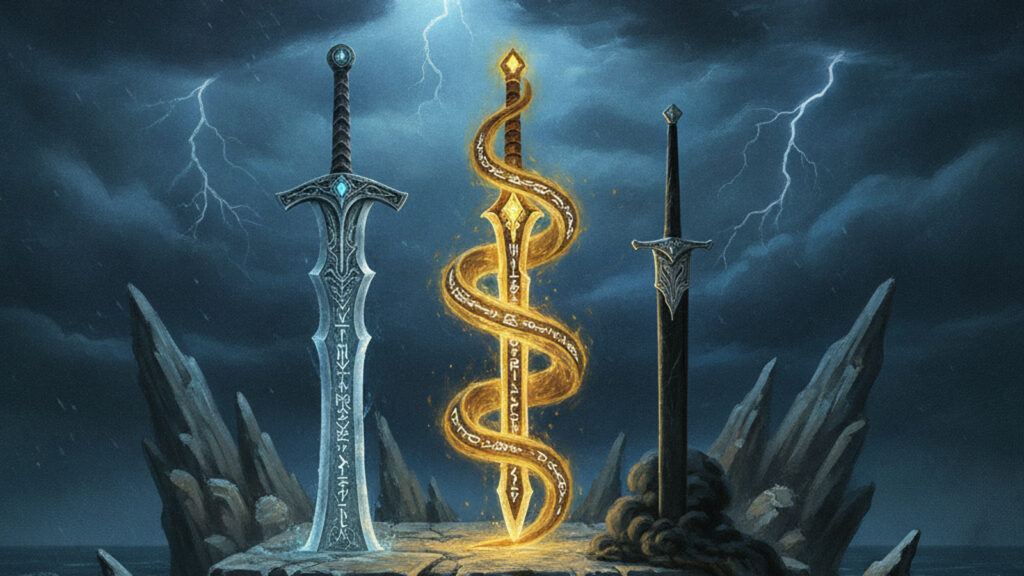
Nightblood is the most powerful of the three, Honorblades come second, and Radiant Shardblades are the most flexible. Honorblades are Honor’s original gifts to the Heralds, Shardblades are spren who become weapons for the Knights Radiant, and Nightblood is an Awakened sword from Nalthis that eats Investiture. Here is how each one works and compares.
What is the difference between Shardblades, Honorblades and Nightblood?
The difference between Shardblades, Honorblades and Nightblood comes down to where each weapon’s power comes from. Coppermind sorts them into three generations. Honorblades are the first: ten swords Honor made from his own Investiture for the Heralds. Radiant Shardblades are the second: spren who watched what Honor did and copied it, turning themselves into metal for a bonded human, which is why Syl tells Kaladin in Words of Radiance that the Honorblades are what the spren are based on. Nightblood is the third: a sword Awakened on Nalthis by Shashara and Vasher, who had seen Shardblades and tried to imitate them with a different magic system. Technically all three count as Shardblades, because Coppermind defines a Shardblade as a heavily Invested weapon, not as a Rosharan one.
| Blade | Source of power | Grants Surges? | Summon time | Biggest drawback |
|---|---|---|---|---|
| Honorblade | Honor’s own Investiture (first generation) | Yes, two Surges to anyone holding it | Bonded and summoned like a Blade | Surges burn far more Stormlight |
| Living Radiant Shardblade | A bonded spren (second generation) | No, the Surges come from the spren bond | Instant | Breaking oaths kills the spren |
| Dead Shardblade | A spren killed at the Recreance | No | Ten heartbeats | Screams at Radiants who touch it |
| Nightblood | Awakening on Nalthis (third generation) | Later learns all ten Surges | Drawn from an aluminum sheath | Drains the wielder’s Investiture and soul |
What is a Shardblade and what can it cut?
A Shardblade on Roshar is a sword often close to six feet long that is still surprisingly light, summoned out of mist and dismissed back into it, with water condensing along the blade as it appears. Shardblades cut stone, wood and metal as if passing through water, leaving perfectly clean edges. Against living things the edge fuzzes and cuts the soul instead of the body: a struck limb turns gray and numb, and a hit to the head or spine makes the victim’s eyes blacken and burn out. Very little stops one. Coppermind lists another Shardblade, Shardplate (which shatters after about two blows to the same spot), the half-shards of Jah Keved, heavily Invested objects and aluminum, which is rare on Roshar because it only comes from Soulcasting. For the Radiant side of this magic, see our guide to the Ten Orders of the Knights Radiant.
What is the difference between living and dead Shardblades?
Living Shardblades belong to active Knights Radiant, and the Blade is the spren itself. A living Blade appears instantly, can talk to its Radiant, glows faintly with the order’s color, can dull its edge on command, opens Oathgates and can harm spren. Shape is flexible too: Coppermind notes a living Blade can become a spear, a shield, an axe or a hammer, as long as it stays metal and the Radiant understands how the object is built. That flexibility is why Kaladin can fight with Syl as a spear, a weapon the Windrunners prefer, as our Windrunners guide explains. The cost is fragility. If a Radiant keeps breaking their oaths, the Nahel bond weakens and snaps, killing the spren and leaving its body frozen as a dead Shardblade in the shape of a sword.
Dead Shardblades are the Blades most Alethi nobles carried before the Radiants returned, and almost all of them date from the Recreance, when the Knights Radiant abandoned their oaths. Each one has a gemstone set in the pommel or crossguard, and bonding a new owner means keeping the Blade close for five days. Because the spren is only mostly dead, it syncs to the bearer’s heartbeat, so summoning takes ten heartbeats instead of an instant. A dead Blade cannot change shape, cannot open an Oathgate, and vanishes when dropped unless its owner wills it to stay. Radiants who touch one hear the dead spren screaming, and in Shadesmar these spren wander as deadeyes with scratched-out eyes. The full story of how they died is in our Recreance explainer.
What makes an Honorblade different from a Shardblade?
An Honorblade differs from a Radiant Shardblade because it is not a spren at all. The ten Honorblades are pieces of Honor’s own Investiture, crystallized into metal, and each grants the two Surges of the Herald who carried it to anyone holding it, with no oaths and no Nahel bond. Jezrien’s Blade gives Adhesion and Gravitation, the Windrunner Surges; Nale’s gives Gravitation and Division, the Skybreaker Surges. Coppermind lists the catch: Honorblade Surgebinding is weaker than a Radiant’s, healing is less efficient, and every Surge needs more Stormlight, sometimes to dangerous levels. While summoned, an Honorblade also turns its holder’s eyes the color tied to its Surges, sapphire blue for Jezrien’s. Honorblades cannot change shape, but they open Oathgates, do not vanish when dropped, and are near indestructible.
The history of the Honorblades explains how Szeth ended up with one. At Aharietiam nine Heralds left their Blades on the battlefield and walked away from the Oathpact, and Taln’s Blade went back to Braize with him. The Shin recovered the nine, guarded them for millennia and trained bearers called Honorbearers. Szeth was given Jezrien’s Blade, and when he was declared Truthless the Shin let him keep it, so the Assassin in White killed Gavilar Kholin and other rulers with a Herald’s weapon. After his duel with Kaladin at the Battle of Narak, the Blade passed to Kaladin, then to Bridge Four, and was later stolen and ended up with Moash. How those two fighters compare is covered in Kaladin vs Szeth: Who Would Win in a Duel.
What is Nightblood and where does it come from?
Nightblood is a sentient black sword from Nalthis, the world of Warbreaker. Shashara, one of the Five Scholars, created it with help from Vasher, spending a thousand Breaths to Awaken a steel sword with the Command “Destroy evil.” The sword had no idea what evil was, so it decided for itself that evil meant someone who would take it and use it for evil purposes. That definition shapes how it treats people. Coppermind explains that someone the sword judges evil feels drawn to it, and once they draw it they slaughter everyone nearby before turning the blade on themselves. Someone good feels sick just looking at it and may vomit when touching it. Nightblood itself is cheerful, eager to please and childlike, and it greets Szeth with “Would you like to destroy some evil today?”
What happens when you draw Nightblood?
Drawing Nightblood is the most dangerous thing a character can do with a sword in the Cosmere. Even sheathed it deepens colors around it, and simply unclasping it lets inky black smoke leak out and fall downward, the reverse of the rising white mist of a normal Shardblade. Fully drawn, Nightblood feeds on the wielder’s Investiture, Breaths on Nalthis and Stormlight on Roshar, faster the longer it is held. The arm turns black, then the body, and once the Investiture is gone it feeds on the wielder’s soul. Coppermind notes that whatever it wounds is destroyed in all three Realms, Physical, Cognitive and Spiritual, so people and objects vanish in smoke at a nick. At the Battle of Thaylen Field, Szeth used it to kill hundreds of enemies, including the thunderclast Yushah, and nearly drained himself and Lift dry.
Which blade is the most powerful?
Nightblood is the most powerful blade in the Stormlight Archive, and the evidence for that ranking is concrete. Coppermind calls it several orders of magnitude more powerful than a Radiant’s Shardblade and possibly stronger than the Honorblades, and the books back that up: during the campaign in Emul, Szeth used Nightblood to sever Ishar’s attempt to steal Dalinar’s bond, then chipped Ishar’s Honorblade, the only damage to an Honorblade on record. Spoilers for Wind and Truth follow. Nightblood kills Rayse, the Vessel of Odium, before Taravangian takes up the Shard, and in Shinovar it learns to use Surges by talking to the Honorblades. Even Hoid, who is very hard to kill, is said to fear it. Honorblades rank second, with near indestructibility and free Surges, and Radiant Shardblades rank third in raw power.
Raw power is not the same as the best blade to carry, and here the ranking flips. A living Radiant Shardblade is the only one of the three that grows with its wielder, changes shape on demand, talks back, costs nothing to summon and never tries to eat its owner. Honorblades give Surges to anyone, but they burn Stormlight fast and turned the Shin Honorbearers into targets. Nightblood wins any fight it touches and can still kill the person holding it, which is why Szeth was warned to draw it only in emergencies and only when full of Stormlight. For a duelist who wants to live, a Blade bonded to a loyal spren beats both. For the bigger matchups behind these weapons, see Vin vs Kaladin and our Skybreakers guide.
Frequently asked questions
What is the difference between a Shardblade and an Honorblade?
Honorblades are the ten original Blades Honor gave the Heralds, made from his own Investiture, and anyone holding one can Surgebind without a spren bond. Radiant Shardblades are spren who take metal form for a bonded Knight Radiant. Coppermind calls Honorblades the first generation and spren Blades the second, built in imitation of them.
Is Nightblood a Shardblade?
Yes, in the technical sense. Coppermind defines a Shardblade as a heavily Invested weapon, and Nightblood qualifies even though it was Awakened on Nalthis rather than formed from a Rosharan spren. It is described as a third generation Blade, after Honorblades and spren Blades.
Can Nightblood cut an Honorblade?
Yes. Honorblades are near indestructible, and Nightblood is the only thing known to damage them. During the campaign in Emul, Szeth used Nightblood against Ishar and it chipped a piece off Ishar’s Honorblade, which shocked Ishar into fleeing.
Why do dead Shardblades take ten heartbeats to summon?
A dead Shardblade is the body of a spren killed when its Radiant broke their oaths. The spren is mostly, not fully, dead, so it syncs to the bearer’s heartbeat while it is summoned, which takes ten heartbeats. A living Radiant Blade appears instantly.
Who made Nightblood?
Nightblood was created on Nalthis by Shashara with help from Vasher, two of the Five Scholars in Warbreaker. Shashara used a thousand Breaths to Awaken a steel sword with the Command “Destroy evil,” and the sword had to work out for itself what evil meant.
The Way of Kings is the perfect entry point. Available in print, Kindle, and audiobook.
The Stormlight Archive audiobooks - narrated by Michael Kramer & Kate Reading - are 40–57 hours each. The best use of a commute in fantasy history.