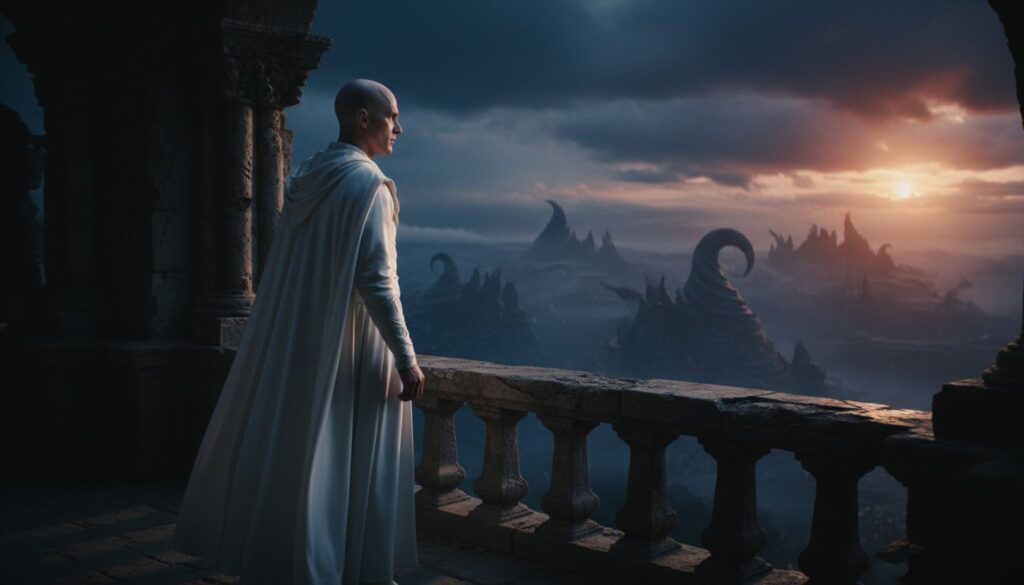
Szeth-son-son-Vallano – the Assassin in White – is one of the most tragic and compelling characters in Brandon Sanderson’s Stormlight Archive. He is introduced in the prologue of The Way of Kings as a killer of supreme skill, murdering a king with terrifying precision. He spends the first two books as the most feared figure in the world. By the end of the series, he is something far more complex.
This guide covers everything about Szeth: who he is, why he kills, his Skybreaker powers, his arc across all five books, and his relationship with the sentient sword Nightblood – one of the most dangerous objects in the entire Cosmere.
Who Is Szeth?
Szeth is a Shin – a member of the Shin people, an isolated culture from the continent of Shinovar, the one region of Roshar sheltered from the Highstorms by a massive mountain range. The Shin have a deeply reverent relationship with stone and soil, considering it sacred. Their culture is largely pacifist, and warriors – those who kill – are considered the lowest caste in Shin society.
Szeth was declared Truthless by the Shin elders – their ultimate social condemnation. A Truthless person is considered to have spoken lies so great that they have forfeited their right to self-determination. They must obey whoever holds their Oathstone – a small stone that passes from master to master, and whose holder has absolute command over the Truthless person’s actions.
The terrible irony: Szeth was declared Truthless for telling the truth. He warned the elders that the ancient enemies were returning – that the Voidbringers were coming back. They declared him mad and a liar. They gave him to a trader as a slave. And then, years later, events began to prove him right.
Szeth’s Powers: Skybreaker and Honorblade
The Honorblade
In the early books, Szeth’s power comes not from a Nahel bond with a spren but from a Honorblade – one of the original weapons of the Heralds, the near-divine figures who led humanity against the Voidbringers in the ancient past. Honorblades grant Surgebinding powers without requiring a spren bond or the speaking of Oaths. They are extraordinarily rare and extraordinarily powerful.
Szeth’s Honorblade grants him the Surges of Gravitation and Pressure – the same Surges as a Windrunner – giving him flight, gravity manipulation, and the ability to move at extraordinary speeds. His combat style is unlike any other figure in the series: he attacks from impossible angles, using gravity to fight on ceilings and walls, cutting through Shardplate that should be impenetrable.
Nightblood
By Words of Radiance, Szeth comes into possession of Nightblood – a sentient sword created on Nalthis (the world of Warbreaker) that is arguably the single most dangerous weapon in the Cosmere. Nightblood was created by Vasher with an enormous investment of BioChromatic Breath – the magic of Nalthis – and given a single command: destroy evil.
The problem: Nightblood has no capacity to understand what evil actually is. When drawn, the black-smoking blade destroys everything it touches indiscriminately, consuming the Investiture (magical energy) of whatever it cuts. Holding it while wielding it corrodes the wielder’s soul. Most people who draw Nightblood die.
Szeth is one of the few beings in the Cosmere with enough Stormlight to wield it without being immediately destroyed. The relationship between Szeth and the cheerfully oblivious Nightblood – a sword that knows it is meant to kill evil but cannot understand why everyone finds it unnerving – is one of the series’ darkest and most strangely funny dynamics.
Skybreaker
In Oathbringer, Szeth formally bonds a highspren and becomes a Knight Radiant of the Skybreaker order. Skybreakers are the order of law – they are bound absolutely to rules and codes rather than individuals, and their power grows through adherence to their chosen law, not through personal relationships. Their Surges are Gravitation and Division.
The irony of Szeth becoming a Skybreaker – the order defined by absolute devotion to law – is rich: he has spent his entire life bound by an externally imposed law (the Oathstone) that compelled him to commit acts he found morally abhorrent. As a Skybreaker, he must choose his own law and follow it absolutely. For Szeth, this becomes a profoundly different kind of bondage.
Szeth’s Character Arc: Guilt, Obedience, and Judgment
The Way of Kings: The Weapon
In book one, Szeth functions primarily as a force of terror. His POV chapters – sparse but devastating – reveal a man in constant psychological anguish. He does not want to kill. He does not believe the murders he commits are just. But he is Truthless, and his Oathstone passes from holder to holder, each one ordering more killings. He has no choice – or believes he has none.
The prologue scene, where Szeth kills King Gavilar with clinical precision while inwardly weeping, establishes the series’ central tension: can a person be responsible for atrocities they were compelled to commit?
Words of Radiance: The Reckoning
Szeth’s arc in book two culminates in a confrontation with Kaladin Stormblessed on the Shattered Plains. The battle between them – a former slave with earned Stormlight powers versus a Truthless assassin with a Herald’s Honorblade – is one of the finest action sequences in the series. It ends in a way that should be final but is not.
Oathbringer and Rhythm of War: Nale’s Student
Szeth is trained by Nale (Nalan), one of the original Heralds – an ancient being driven to madness by millennia of torture and rebirth who now leads the Skybreakers with rigid, terrifying legalism. Nale believes that preventing the return of the Voidbringers is worth any atrocity. Szeth, who has spent his life committing atrocities in the name of obedience, finds himself again in the service of a master whose orders he cannot fully justify.
Wind and Truth: The Judgment
Wind and Truth is where Szeth’s arc reaches its necessary conclusion. His chapters include some of the most visually striking and emotionally raw material in the entire series. Szeth must confront the Shin elders who declared him Truthless – who made him a weapon – and determine what justice means when the guilty are also the society that defines guilt.
His resolution with Nightblood, and what he ultimately does with the sword, is one of the book’s most anticipated and debated moments. Fans consistently rank Szeth’s arc in Wind and Truth as among the best in the novel.
Szeth and Nightblood: The Odd Couple
The dynamic between Szeth – a man consumed by guilt over every life he has taken – and Nightblood – a sword that wants nothing more than to destroy evil and genuinely does not understand why nobody will let it help – is one of Sanderson’s most inspired character pairings.
Nightblood communicates telepathically with whoever is carrying it, expressing enthusiasm, curiosity, and a complete inability to grasp why drawing a soul-destroying weapon in a library or a conversation is considered inappropriate. Szeth’s responses – exhausted, pained, occasionally almost fond – are some of the darkest comedy in the series.
Szeth’s Connection to the Broader Cosmere
Nightblood is a crossover object from Warbreaker – readers who have encountered it in that novel get significantly more context for its nature and its terrifying potential. Vasher, Nightblood’s creator, also appears in the Stormlight Archive under a different name. Reading Warbreaker before Oathbringer is specifically recommended for this reason. See the full reading order guide →
Frequently Asked Questions
Is Szeth a villain?
In the early books, Szeth functions as an antagonist – he is the threat Dalinar and the other Highprinces fear. But he is never a villain in the moral sense. His atrocities are compelled; his own moral compass consistently identifies them as atrocities. He is a character whose agency has been stolen, not one who chose evil.
What is Szeth’s Oathstone?
A small stone that functions as the physical symbol of a Truthless person’s obligation. Whoever holds it is Szeth’s master. The stone passes between multiple holders over the first two books, each one ordering him to kill different targets, until the chain is finally broken.
Does Szeth ever find peace?
His arc in Wind and Truth represents the closest thing to peace that a character shaped entirely by compelled violence can achieve. It is not a simple or comfortable resolution – but it is honest, and it is earned.
Where does Szeth appear in the series?
Szeth has POV chapters in The Way of Kings (prologue and sporadic chapters), Words of Radiance, Oathbringer, and becomes a major POV character in Wind and Truth, which is as much his book as it is Dalinar’s.
Where to Start
- The Way of Kings on Amazon – Szeth’s introduction in the prologue
- Warbreaker on Amazon – Read before Oathbringer for Nightblood context
- Wind and Truth on Amazon – Szeth’s defining book
Full series audiobooks: Try Audible free →
The Way of Kings is the perfect entry point. Available in print, Kindle, and audiobook.
The Stormlight Archive audiobooks - narrated by Michael Kramer & Kate Reading - are 40–57 hours each. The best use of a commute in fantasy history.