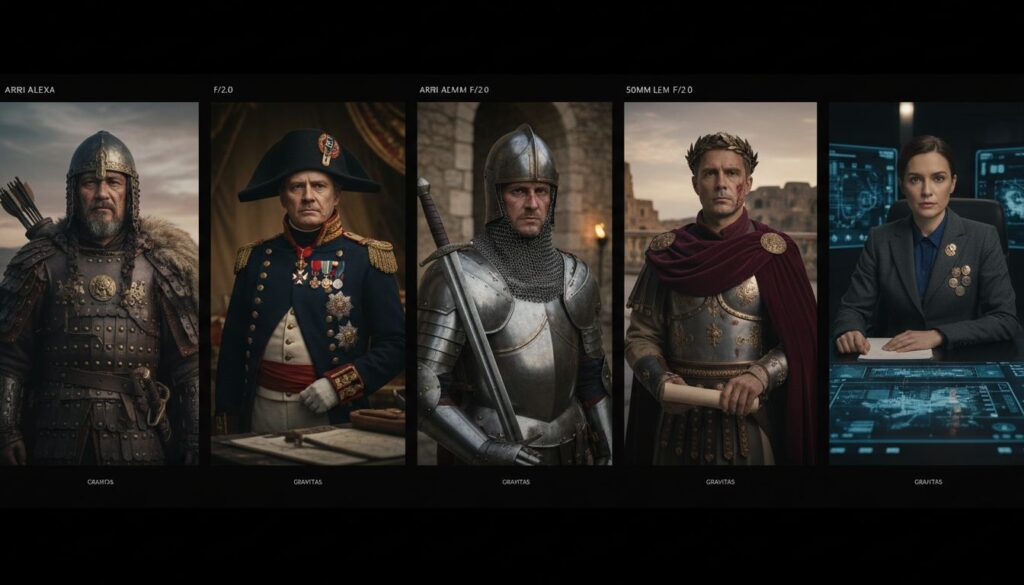
One of the most interesting things about the Stormlight Archive is how specific and recognizable its characters feel – not as fantasy archetypes, but as real human patterns. Dalinar Kholin is not a generic fantasy king. He is a very specific kind of person: the military genius who wins through violence, experiences a moral crisis, and then tries to build something instead of destroy it. That’s not a fictional character type. That’s a historical one.
These are the real-world figures who were, in some meaningful sense, Dalinar Kholin.
Marcus Aurelius – The Philosopher-Emperor Who Hated the Job
Marcus Aurelius was the most powerful man in the world during his reign – Emperor of Rome, commander of its armies, final word on life and death across an empire of tens of millions. He spent his evenings writing private journal entries reminding himself not to enjoy any of it.
Meditations – his private notebook, never intended for publication – is essentially a Dalinar Kholin fever dream. A man of enormous power, surrounded by violence and political ambition, writing to himself: You have power over your mind, not outside events. Realize this, and you will find strength. Then waking up and going back to war because someone had to.
The parallel is precise. Dalinar has his visions. Marcus had his philosophy. Both are men who arrived at a sense of ethical responsibility through hard experience rather than natural virtue – who were, at earlier points in their lives, considerably less admirable – and who then spent the rest of their careers trying to govern according to principles they weren’t always sure they deserved to hold.
The key difference: Marcus never stopped fighting the wars he was born into. Dalinar, eventually, refuses a war that isn’t necessary. One step ahead.
Ulysses S. Grant – The General Who Won Everything and Hated Violence
Grant is one of the most misread figures in American history. The popular image is a cigar-chomping bruiser who won the Civil War through attrition. The reality is more interesting: Grant was a man who genuinely disliked violence, had a weak stomach for blood, could not eat meat if he could see the animal it came from, and was visibly uncomfortable at military parades. He was also one of the most ruthlessly effective military minds of the 19th century.
Sound familiar?
Dalinar didn’t enjoy the killing either. He enjoyed the war – the clarity of it, the purpose, the simplicity of objective. But even at his worst, as the Blackthorn, there’s evidence in the flashbacks that he was not a man who relished suffering. He relished winning. Those are different things, and the distinction matters.
Grant after the war – struggling with civilian life, struggling with politics, struggling to convert military clarity into peacetime governance – is another Dalinar chapter waiting to be written.
Charlemagne – The Unifier Who Unified With a Sword
Charlemagne united the fragmented kingdoms of Western Europe into the Carolingian Empire through a combination of military conquest, political marriage, and the constant implied threat of more military conquest. He then spent decades trying to build administrative infrastructure, support the Church, fund literacy programs, and act like a civilized ruler.
Gavilar Kholin unified Alethkar. Dalinar was the weapon that made that unification possible. The Blackthorn’s campaigns – systematically reducing recalcitrant kingdoms through overwhelming force – are structurally identical to Charlemagne’s Saxon campaigns. The goal was always consolidation. The method was always “or else.”
The interesting part is what Charlemagne did next. So is the interesting part of what Dalinar does next. Both men discovered that building is harder than breaking. Both built anyway.
Oliver Cromwell – The Military Genius Whose Religion Got Him in Trouble
Cromwell is a genuinely uncomfortable parallel, and it’s worth including precisely because it’s uncomfortable. He was a military revolutionary who transformed the English army into the most effective fighting force of his era. He was deeply, genuinely religious in a way that motivated his most admirable acts and his most terrible ones. He believed he was an instrument of divine will – and he used that belief to justify atrocities alongside legitimate governance.
Dalinar, at his worst, used the Almighty the same way. The codes say this is acceptable, therefore it is acceptable. I am fighting for unity, therefore the massacre is necessary. The Rift didn’t happen despite Dalinar’s values. It happened partly because of them, applied badly.
Cromwell never had a Cultivation. Never got the reset. The question the Stormlight Archive is asking – whether a man shaped by atrocity can genuinely change – is the question Cromwell’s legacy leaves perpetually open.
Nelson Mandela – The Part of the Arc Dalinar Is Aiming For
Here’s where the comparison becomes aspirational rather than descriptive. Mandela spent 27 years in prison for acts of political violence – he was not, in his early career, committed to non-violence – and emerged to lead a process of reconciliation that most people expected to become a bloodbath.
The Truth and Reconciliation Commission was, in some ways, the most Bondsmith thing anyone has done in real history: an attempt to acknowledge terrible things that happened and move forward without either ignoring them or letting them become the foundation of the next round of violence.
Dalinar’s project – uniting Roshar against an existential threat, building a coalition of people who have every reason to distrust each other, holding himself accountable for the Rift while refusing to let that guilt become paralysis – is Mandela’s project with Shardplate.
Neither man fully succeeded. That’s also part of the parallel.
Genghis Khan – The One We Don’t Skip
We’ve covered this elsewhere on this site in more detail, but the Genghis Khan parallel is too central to ignore here. The unification-through-conquest model, the personal ferocity combined with genuine administrative innovation, the sons who couldn’t maintain what the father built – these are structural elements of Dalinar’s backstory, not coincidences.
Sanderson has acknowledged the influence. The Alethi expansion campaigns, the Kholin family dynamics, the tension between military brilliance and the inability to govern peacefully – all of it maps.
The crucial difference: Genghis Khan never questioned the conquests. Dalinar eventually does. That’s the whole story.
The Pattern
What all of these figures share isn’t military genius or political power. It’s the attempt to convert capacity for violence into something else – governance, philosophy, reconciliation, legacy – and the varying degrees to which they succeeded.
Dalinar Kholin is not a fantasy character who happens to look like historical figures. He is an examination of a specific human pattern: what happens after the war, to the person who won it, when winning turns out not to have solved anything.
The Stormlight Archive’s answer to that question is more optimistic than history usually provides. Make of that what you will.
More character deep dives: Dalinar Kholin Complete Guide · Kaladin Stormblessed · Szeth
Start the series: The Way of Kings on Amazon →
The Way of Kings is the perfect entry point. Available in print, Kindle, and audiobook.
The Stormlight Archive audiobooks - narrated by Michael Kramer & Kate Reading - are 40–57 hours each. The best use of a commute in fantasy history.