Roshar is the primary world of Brandon Sanderson’s Stormlight Archive – and one of the most alien, fully realized fantasy settings in modern literature. It is not a medieval European analogue with different names. Roshar is a world built from genuinely different physical laws, biology, and history, and understanding its nature is essential to understanding why the series feels unlike anything else in the genre.
This guide covers the essential facts about Roshar: its geography, its ecology, its storms, its peoples, and the ancient history that drives the conflict of the Stormlight Archive.
The Physical World of Roshar
Stone, Not Soil
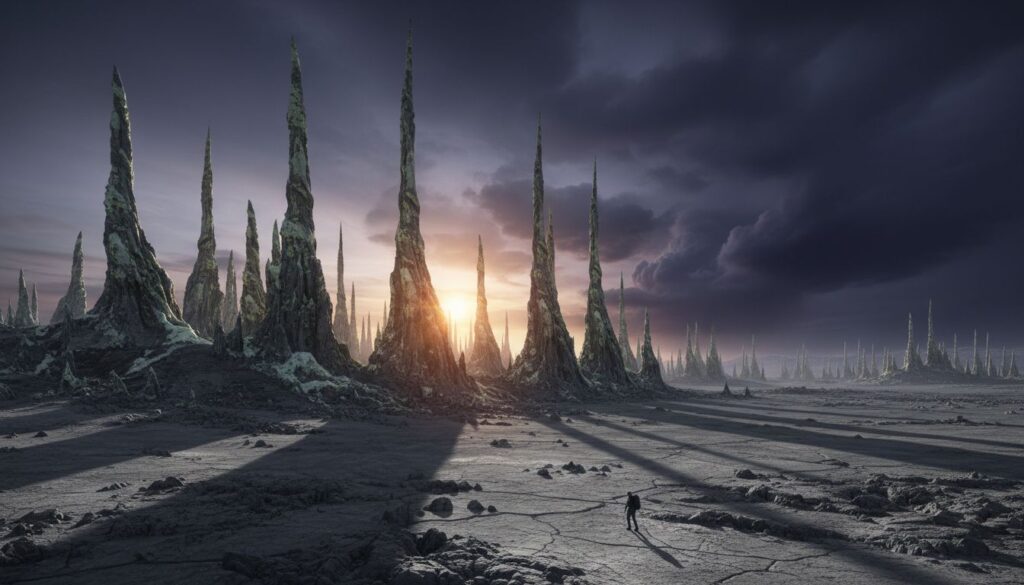
The single most striking feature of Roshar is what is absent: soil. The surface of most of Roshar is bare rock – smooth stone plains, stone cliffs, stone valleys. There is no topsoil in the conventional sense. The reason is the Highstorms.
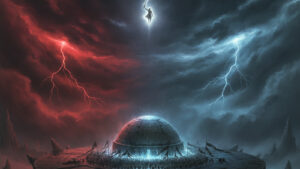
Roshar is periodically swept by continent-scale storms called Highstorms that travel from east to west across the entire planet. These are not ordinary storms – they are massive weather events carrying hurricane-force winds, torrential rain, and a phenomenon called Stormlight: the magical energy infused into gemstones during a Highstorm that powers the magic of the Knights Radiant. A Highstorm can last hours or days, and anything not sheltered in stone will be destroyed.
The result: over geological time, Highstorms have scoured Roshar’s surface clean. Soil does not accumulate. Soft organic matter cannot survive in the open. Roshar’s ecology adapted over millions of years to this reality.
The Ecology of Roshar
Life on Roshar evolved to survive the Highstorms, and everything about its biology reflects this:
Rockbuds are the dominant plant form – hard-shelled organisms that contain plants inside. They open between storms and retract instantly when touched or when a storm approaches. What looks like stone on the surface may be closed rockbuds waiting for calmer weather.
Grass on Roshar retracts into the ground when touched or when a storm comes. The famous “knocking” sound of Rosharan grasslands – the rapid retraction of millions of grass blades simultaneously as a storm front arrives – is one of the series’ most distinctive sensory details.
Greatshells are enormous crustacean-like creatures – the apex fauna of Roshar. Chasmfiends, the most recognizable, can be the size of buildings. They have hard shells (carapace) that protect them from Highstorms and predators. Much of Roshar’s protein economy runs on greatshell meat. The chrysalis of a chasmfiend contains gemhearts – enormous gemstones naturally infused with Stormlight – which are the most valuable resource on the planet.
Spren are the most unique feature of Rosharan ecology. They are living fragments of Investiture – the magical energy of the Cosmere – that manifest as physical presences when emotional or physical concepts reach a threshold. Windspren follow gusts of wind. Flamespren dance in fires. Fearspren wriggle up from the ground around frightened people. There are thousands of types, from barely-conscious to near-human intelligence. The most powerful become the bonded companions of Knights Radiant.
Architecture
Because Highstorms destroy anything built in open terrain, Rosharan architecture clusters around features that provide shelter. Cities are built into cliff faces, carved from existing rock formations, or positioned in the leeward side of large rock formations that block storm winds. The most sophisticated Rosharan cities are almost entirely underground or inside stone.
The Shattered Plains – the massive network of stone plateaus where much of the first three books’ military action takes place – is believed by most characters to be a natural geological formation. Its true nature is one of the series’ larger reveals.
The Peoples of Roshar
Roshar has multiple distinct cultures and peoples, most of which observe the Vorin religious tradition (or its variants) while having distinct national identities.
Alethkar is the dominant military power of the eastern continent – the kingdom of the Kholin family. Alethi culture is warrior-focused, with a strict division between lighteyes (the nobility, identified by light-colored eyes) and darkeyes (the common people). Social rank is determined by eye color, with lighteyes holding almost all political and military power.
Kharbranth is a neutral city-state built into a cliff face, governed by a benevolent ruler and known throughout Roshar for its medical expertise and its enormous library. Shallan’s arc in book one takes place largely in Kharbranth.
Shinovar is the isolated western region sheltered from Highstorms by the Misted Mountains. It is the one place on Roshar with actual soil and conventional agriculture. The Shin people – pale, wide-eyed, deeply pacifist – are culturally alien to the rest of Roshar. Szeth is Shin.
The Parshendi – later revealed as the Singers – are the other sapient species of Roshar. They can change their physical form by bonding different types of spren, giving them access to different forms with distinct physical and mental capabilities. Their history, and their relationship to the ancient enemies called Voidbringers, is central to the Stormlight Archive’s cosmological conflict.
The Highstorms
Highstorms are so central to Rosharan life that the entire civilization is organized around them. A Highstorm’s arrival is tracked and predicted – its schedule is one of the most important pieces of information in any military campaign. Armies plan marches around storm timing. Merchants calculate travel routes by storm windows. Children learn to read the stormwardens’ predictions before they learn anything else.
The eye of a Highstorm – the brief, calm period at its center – is the most sacred moment in Vorin religion. The god-figure of Vorinism, the Almighty, is said to dwell in the Highstorm. Knights Radiant draw their power from the Stormlight deposited in gemstones during Highstorms. The storms are not merely weather – they are the mechanism by which Roshar’s magical economy operates.
Crem is a byproduct of Highstorms – a mineral-rich slurry deposited by storm water that accumulates on surfaces over time. Crem is both nuisance and resource: it clogs mechanisms and must be cleared from equipment, but it is also the primary building material on Roshar, hardening into a durable stone-like substance when dried. Rosharan buildings are often a mix of natural rock and crem-mortar.
The Ancient History: Desolations and the Knights Radiant
Roshar’s present is shaped by a history most of its people have forgotten or distorted. Long before the events of the series, Roshar was periodically attacked by forces called Voidbringers – an ancient enemy that drove humanity almost to extinction in series of catastrophes called Desolations.
The Knights Radiant were humanity’s response – warriors who bonded spren and gained supernatural powers through the Surgebinding system. Ten orders of Radiants, each with different powers tied to different spren types, fought the Voidbringers across thousands of years of Desolations.
The Desolations ended – but the way they ended, and what the Knights Radiant did immediately afterward (an event called the Recreance, where they collectively abandoned their spren and their Shardblades), is one of the central mysteries driving the series. The present-day conflict – the return of the Voidbringers, the re-emergence of the Knights Radiant, and the contest between Dalinar and Odium – is a direct consequence of choices made in that ancient history.
The Cosmere Context
Roshar is one world in the broader Cosmere universe. Its unique ecology, magic system, and the extreme nature of its storms are all connected to the presence of the Shard of Honor – a fragment of a god-like being whose Investiture infuses the world’s gemstones during Highstorms and powers Surgebinding. The conflict of the Stormlight Archive is fundamentally a conflict between two Shards: Honor (dead by the start of the series) and Odium (the Shard of Hatred), the most destructive force in the Cosmere.
Readers who have read other Cosmere novels will recognize the mechanics of Shards, Investiture, and worldhopping in the Stormlight Archive. For new readers, none of this background is required – the books explain what matters when it matters.
Frequently Asked Questions
Is Roshar based on any real-world culture?
Alethkar draws some inspiration from historical steppe cultures and the Mongolian empire period – the warrior aristocracy, the expansion campaigns, the emphasis on military excellence. But Roshar is not an analogue. Its ecology, geography, and societies are original constructions.
Why is there no wood on Roshar?
There is limited wood – it exists in Shinovar and a few other sheltered regions – but it is extraordinarily rare and valuable everywhere else. Buildings are stone. Ships are made of rockwood (the hardened stems of some Rosharan plants) or imported timber. The scarcity of wood is a meaningful constraint on Rosharan technology and economy.
What are Shardblades and Shardplate?
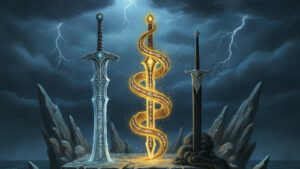
Shardblades are the dead spren of Knights Radiant who abandoned their bonds during the Recreance. Summoned by their current bearers, they kill by severing the soul from the body. Shardplate is the magical armor originally worn by Knights Radiant, now passed down through generations. Both are the most valuable military equipment on Roshar, worth entire kingdoms. The story of how they came to exist – and what it means that they are the corpses of spren – is one of the series’ most haunting revelations.
What is Stormlight?
Stormlight is the magical energy deposited into spheres and gemstones during Highstorms. Knights Radiant inhale it to power their Surgebinding abilities, heal wounds, and enhance physical performance. It glows – a bright, white-blue light – which is where the series gets its name. Running out of Stormlight during a battle is a genuine tactical crisis.
Explore the World
The best way to understand Roshar is to read the books. The world unfolds naturally through the characters’ lives rather than through exposition dumps – by the time you finish The Way of Kings, you will have internalized Roshar’s strangeness.
See also: Complete Reading Order · Dalinar Kholin Guide · Kaladin Stormblessed Guide · Cosmere Reading Order
The Way of Kings is the perfect entry point. Available in print, Kindle, and audiobook.
The Stormlight Archive audiobooks - narrated by Michael Kramer & Kate Reading - are 40–57 hours each. The best use of a commute in fantasy history.